The "Big Three" - Monasteries in Lo Manthang
Lo Manthang is the final destination on the Upper Mustang trek or jeep tour. It is the capital of Upper Mustang and the former kingdom of Lo, established in the 15th century by King Ame Pal.
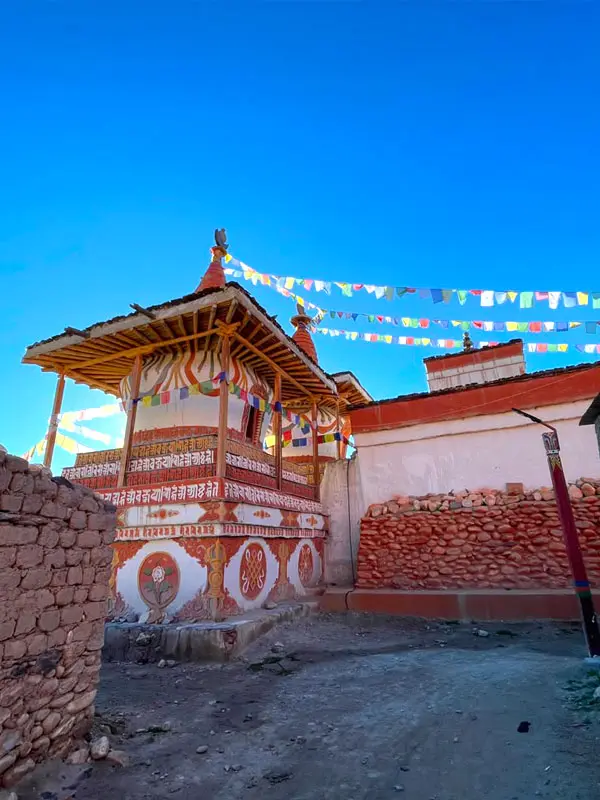
Situated at 3,840 meters, Lo Manthang is the religious heart of Upper Mustang. Jampa Lhakhang, Thuchen Gompa, and Chode Monastery are known as the Big Three monasteries in Lo Manthang.
They host the biggest festivals, pujas, and celebrations throughout the year, including the famous Tiji festival. Below, we have shared more in detail about each monastery:
Jama Lhakhang (Jampa Gompa/Maitreya Temple):
Jama Lhakhang is the oldest Sakya monastery in Upper Mustang. It dates back to the 1380s- 1390s. The monastery was established under the rule of early Lo Kings and Sakya Lamas.
The monastery is decorated with ancient murals that house a statue of Maitreya, the future Buddha of Mahayana eschatology. Around the statue, there is a circumambulation path. It allows you to have a close observation of Maitreya’s serene expression and intricate ornamentation.
The monastery is a three-storey structure adorned with intricate woodwork and traditional Tibetan-style paintings. In the upper gallery (first floor), you can see 14th-century murals depicting bodhisattvas.
The second floor is not accessible to the general public. It houses the most secretive Vajrayana tradition of Tibetan Buddhism.
From the rooftop of the gompa, you can see a panoramic view of Lo Manthang, Chhonhup Valley, and the Annapurna & Dhaulagiri ranges on the horizon.
- Jama Lhakhang plays a significant role in Tiji festival preparation and rehearsal chants.
- In winter, monks perform protective rituals in Jama Lhakhang to summon Maitreya’s blessings for the kingdom’s wellbeing.
- There are 108 ancient mandalas in various sizes in Jama Lhakhang. These mandalas are adorned with gold and silver and include embellishments such as coral, turquoise, and gemstones.

Thubchen Gompa:
The Thubchen Gompa is one of the three significant monastic complexes in Lo Manthang. It was built in the late 15th century during the reign of the third king of Lo, Tashi Gon.
Thubchen Gompa is a grand assembly hall. It is known for its historical architecture. The gompa's massive barn-like interior looks very attractive in the blazing trans-Himalayan sunlight.
You can see high timber pillars supporting the beamed roof and walls displaying 15th-century murals. These murals were restored in the 1990s–2000s with support from the American Himalayan Foundation and the late Lo Gyalpo Jigme Palbar Bista.
Upon entering the monastery, you will be greeted by the Sgo-Mchog room. It has four big statues of the protector kings of the four directions. In the main hall, you can see wooden pillars and a ceiling engraved with sacred mantras.
In the hall, you will also see statues of Avalokitesvara (Chenrezig), Manjushri (Jampayang), and Padmasambhava (Guru Rinpoche). And the centerpiece is the Great Buddha (Thubchen), crafted from copper and meticulously polished in gold.
- Thubchen Gompa has played a crucial role in preserving the spiritual and cultural heritage of Lo Manthang.
- Thubchen Gompa is also a vibrant center for the Tiji festival and draws tourists from around the world. During the festival, monks perform masked dances and rituals here.
Chode Monastery (Dragkar Thegchen Ling):
Chode Monastery was established in the late 13th century by King Ama Pal and the esteemed scholar Ngorchen Kunga Sangpo. It is the primary Sakya Gompa in Lo Manthang.
Chode Monastery or Chode Gompa is Upper Mustang's active monastic college. It has 20-30 young monks and senior Sakya monks. Here, you can see them engaged in daily routines and religious practice that have been continued for centuries.
Unlike Jama and Thubchen monasteries, the Chode Monastery offers unfiltered access to monastic life in the remote Himalayas of Nepal. The Tiji festival rituals, mask dances (tshechu), and cham rehearsals take place here.
- Every pre-dawn dungchen (long horns) blast signals pujas.
- Rhythmic drumbeats accompany butter-lamp offerings.
- Groups of young monks study Tibetan Buddhist traditions, scripture recitation, and classical Tibetan grammar in Chode Monastery.
Namgyal Monastery (Pal Ewam Namgyal Choedhe Thupten Dhargyeling) - the hilltop protector of the region
Namgyal Monastery is located northwest of Lo Manthang on a hilltop at 3,850 meters. You have to walk half a day to reach Namgyal Monastery. Alternatively, many travelers also take a horseback ride.
The Namgyal Monastery is an important seat of the Ngor sub-school of the Sakya order of Tibetan Buddhism.
This monastery is known for hosting the Bagcham Festival. It is an annual sacred masked dance performed by monks to clear negative spiritual obstacles and protect Buddhist teachings.
- The Namgyal Monastery preserves traditional Buddhist philosophy, art, and ritual and passes them to young monks.
- Inside the monastery, there are thankas, ancient murals, and statues.
Ghar Gompa (Lo Gekar) - the hidden secret of Upper Mustang
While we all talk about the three main monasteries of Lo Manthang, Ghar Gompa remains one of the most influential monasteries in Upper Mustang outside Lo Manthang.
The early history of this monastery is buried in myths and legends. It is believed that Guru Rinpoche established Ghar Gompa in the 8th century. The monastery is located between Tsarang and Lo Manthang at 3,930 meters.
Ghar Gompa is affiliated with the Nyingma sect. To reach here, you have to walk a little off the main jeep road. As per the legends, the Ghar Gompa is connected with Samye Monastery in Tibet.
A legend says that Guru Rinpoche faced powerful demons obstructing Samye's construction. He subdued the demons and traveled through Mustang. During that time, he established the Ghar Gompa either before or simultaneously with Samye Monastery in Tibet.
- Visitors here often say that Ghar Gompa carries a very powerful energy. It has small courtyards, and the walls are weathered.
- The inner chapel is dark, soot-covered from centuries of juniper smoke and butter lamps.
- You can see ancient statues of Guru Rinpoche and tantric mandalas inside Ghar Gompa.
- The architecture features a mud-brick building with intricate murals and ancient scriptures.

Luri Gompa (Luri Cave Monastery near Yara)
Luri Gompa is located above the Puyon Khola valley near Yara village. It is associated with the Nyingma Kargyupa Sect of Tibetan Buddhism. The gompa has 2 chambers and is decorated with eight auspicious symbols and four guardian deities.
Travelers usually visit this monastery as a side trip from Lo Manthang or when they extend their Upper Mustang trek/tour itinerary to settlements like Yara and Tangge.
The Luri Gompa is perched around 100 meters up a cliff face. It is a small, whitewashed chapel perfectly balanced on a natural sandstone pillar. The upper cave chamber is only accessible via a narrow, exposed path.
In the Luri Gompa, you can explore the 14th-century murals that reflect Indian and Kashmiri artistic influences. These extraordinary paintings depict tantric yidams, mandalas, and Buddhist deities.
Overall, you will see the finest late-medieval Upper Mustang art in Luri Gompa. The paintings inside the cave monastery include:
- East: the painting of Namgyal
- West: the painting of Khadcheri
- North: the painting of Vajrasattva
- South: the painting of Lokesvara
Nyiphuk (Niphu) Cave Monastery, Chhoser
Nyiphuk Cave Monastery is located in the Chhoser Valley. It is carved into a vertical cliff. To reach this monastery, you have to navigate steep trails, and ladder-assisted climbs are required.
Inside the main shrine chamber, there are butter lamps, a central Buddha or Guru Rinpoche image, and monk cells carved into adjacent rock. Unlike other monasteries in Upper Mustang. The Nyiphuk Cave Monastery presents cave-dweller culture.
It is believed that the first Buddhist practitioners in Upper Mustang came from this cliff gompa. Here, you will feel the true seclusion of monks.
Tsarang Monastery (Tsarang Red Gompa)
Tsarang village has long served as the political and religious center of Lo before Lo Manthang was founded. Here, you explore the Tsarang Red Gompa perched at 3,560 meters. The location of the monastery offers a dramatic view of the gorge and old royal palace ruins.
In the Tsarang Monastery, you will discover a vast collection of ancient Buddhist manuscripts. The monastery's history goes back to the 11th- 13th centuries.
There is an internal courtyard and a library filled with handwritten Buddhist scriptures in Tsarang Monastery. Similarly, the monastery has preserved monastic education for centuries.
Things you should do and don't while visiting monasteries in Upper Mustang
- While visiting any of these major monasteries in Upper Mustang, you should follow the following rules and etiquette:
- Always walk in a clockwise direction around stupas, mani walls, monasteries, and prayer halls.
- Wear modest clothes that cover your shoulders and knees.
- Remove shoes, sunglasses, and hats while entering monasteries.
- Before taking photographs and video, confirm with your guide. Monasteries such as Jama, Thubchen, Luri, and Ghar Gompa prohibit photography inside the main shrine entirely.
- Flash is prohibited near all murals due to UV degradation of the organic binder in ancient pigment.
- You can make cash donations into support boxes.
- You can offer butter lamps, candles, and incense. Definitely ask your guide.
- Keep your voice low throughout the monastery grounds.
- Never point your feet at statues or thangkas (considered deeply disrespectful).
- Do not touch sacred objects, relics, or ancient murals.
- Keep mobile phones silent or off.
- Ask permission before photographing monks. Do not disturb them when monks are meditating or chanting.
Explore the ancient monasteries and rich heritage of Upper Mustang with First Himalayan
You can explore these ancient monasteries and the rich heritage of Upper Mustang comfortably with us. We are one of the top luxury travel organizers in Nepal. Our several years of expertise and knowledge of Upper Mustang make your trip hassle-free and safe.
Our private tours are best for elite travelers, VIPs, celebrities, politicians, and anyone seeking high-end hospitality and transportation in the remote Himalayas of Nepal. If you are looking for a trustworthy Nepali travel company, you are in the right place.
Check our Luxury Upper Mustang Tour package or contact us to customize your own journey. You can also reach out to us anytime if you have any questions.